
When companies explore options to reduce the price of a plastic component, they usually begin with the most evident options, for example, “Is it possible for us to use a cheaper plastic?” or “Is it possible for us to make a cheaper mold? “. Although these are valid questions, in many cases they overlook the most impactful factor of the entire production process: Cycle Time.
At Montrose Molders Corp, we understand that in the case of high-volume production, time is not only money but time represents a big part of money. A few seconds that are cut from cycle time might amount to the savings of thousands or even hundreds of thousands of dollars during the lifetime of a project.
What Exactly is Cycle Time?
In injection molding cycle time refers to the overall duration of making a single “shot” (i. e. the finished product or a set of them). You can even describe it as a heartbeat: the higher and steadier it is the more efficient is the machine. One cycle is made up of six main steps:
- Injection: Filling the mold with hot, liquid plastic.
- Packing: Holding pressure to make sure the mold is completely full.
- Cooling: Waiting for the plastic to turn back into a solid. (This is the longest step!)
- Mold Opening: The two halves of the tool pull apart.
- Ejection: The part is pushed out of the mold.
- Mold Closing: The tool shuts, and the process starts again.
If a part takes 30 seconds cycle time the machine is capable of making 120 shots per hour. What if you bring it down 25 seconds? Now your production comes up to 144 shots per hour! This is an enormous increase in productivity just by changing the cycle time without getting a single additional machine.
Why Cycle Time is the #1 Cost Driver
Injection molding costs are most often determined by the amount of time the machine is used. Paying for plastic is only a part of the cost; you are actually renting a very expensive, high-tech machine, along with paying for the electricity to run it and the labor to supervise it.
- Shorter Cycle Time = More parts per hour = Lower cost per part.
- Longer Cycle Time = Fewer parts per hour = Higher cost per part.
Since the machine hourly rate is constant, making each part cheaper individually depends on producing them faster.
The Big Five: What Affects Your Speed?
How long it takes to make your part – 10 seconds, 60 seconds, or an hour – depends on several factors:
- Cooling Time (The 80% Rule)
In most instances, cooling makes up between 60% and 80% of the whole cycle time. When the plastic is injected in the mold, it is very hot and it has to cool down sufficiently to keep the shape before it can be taken out. If the cooling system in the mold is inefficient or the part is very thick, the machine will just be idle, and that is money lost.
- Wall Thickness
It is the leading cause of design errors. A wall two times thicker will not only take twice as long to cool but May take four times as long. By making parts with thin and consistent walls and using “ribs” for strength rather than solid plastic blocks, cycle times can be greatly reduced.
- Material Selection
Some plastics will be ‘faster’ than others. Certain resins can either quickly release heat or be easily spread in the mold. For instance, you will almost always end up with a longer cooling time if you pick a material whose melting point is extremely high.
- Injection Mold
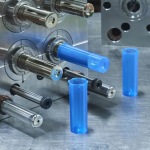
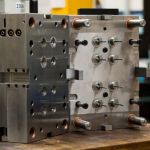
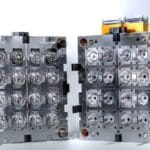
Design A ‘cheap’ mold most probably has simple cooling lines. A top-level mold (like an SPI Class 101) is equipped with conformal cooling, where water channels are in the shape of the part to efficiently remove the heat. Spending more on the mold initially is okay, but the quicker cycle time will continue paying you every day that there is production.
- Automation
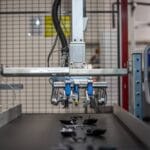
Using robots to ‘pick’ parts out of the mold is often faster and more consistent than a human operator. Consistency is essential; when the cycle is exactly the same every time, the mold is at the same temperature, which helps to prevent defects.
Small Changes, Big Results: A Real-World Example
Let’s examine the calculations involved in a program producing 1 000 000 parts:
Original Cycle: 30 seconds.
Optimized Cycle: 27 seconds (a 10% improvement).
That small 3-second time saving can save you 833 hours of machine usage. At a typical shop rate, a 10% performance increase in this manner could mean tens of thousands of dollars in pure profit or savings these being ongoing savings that remain until the product is changed.
The Balance: Speed vs. Quality
You can’t just bring the speed to 100 and pray for a miracle. If you take out a component even before it has been cooled down enough, you’ll face issues with quality such as:
- Warpage: The part twists as it continues to cool outside the mold.
- Sink Marks: The surface caves in because the center is still molten.
- Short Shots: The plastic freezes before it fills the whole cavity.
The aim is to figure out the “sweet spot” where the component can be made the fastest without compromising the design quality.
Final Thoughts
At Montrose Molders Corp. we don’t simply “push the button.” Rather, we consider everything that surrounds the project. We assist our clients to enhance their designs and their tooling so that the cycle time is as short as possible. If your intention is to reduce your manufacturing expenses, just checking the resin price might not be enough. Use the clock to get the most out of your production.
Would you like to make your production more efficient? Reach us now for a design consultation, and together, we will figure out how many seconds can be reduced from your cycle.