
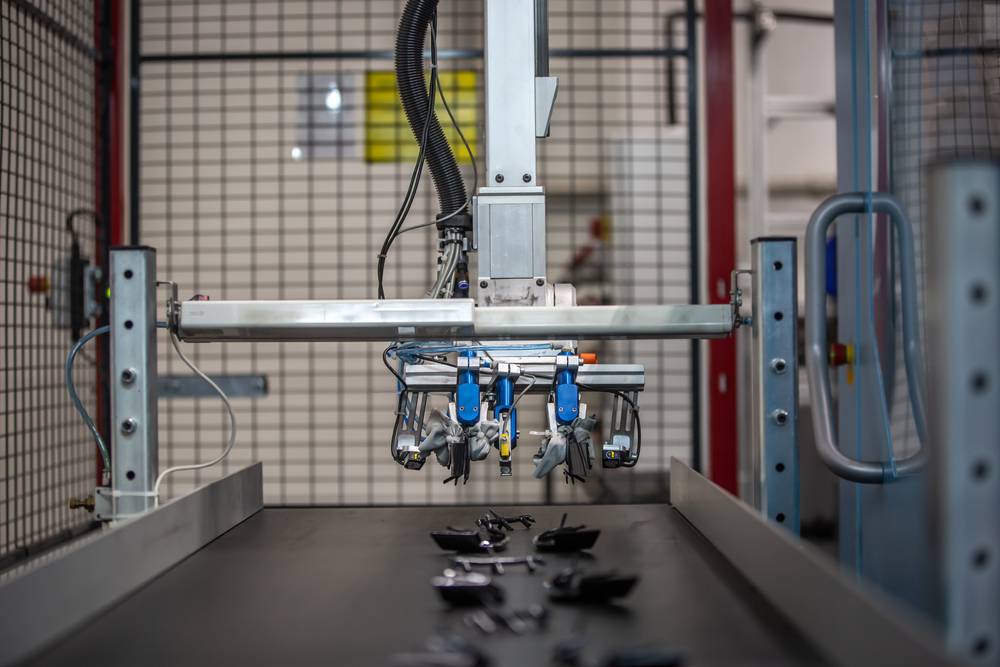
Automation is frequently hailed as the silver bullet for efficiency in the evolving world of plastics manufacturing. The development of robotic part removal processes and entirely self-operating production cells with no lights on is testament to the move towards “smarter” factories. Nevertheless, automation is not always synonymous with cost reduction.
It is capable of delivering incredible cost and consistency benefits when implemented correctly but may also result in complicated and costly solutions if it is the wrong context. OEMs are faced with a dilemma: how to know if investing in a robot will be profitable or if a flexible, manual solution is better. Montrose Molders Corp’s view is that the ideal plan is a combination of high-tech accuracy and human flexibility, which depends on the particular needs of the program.
Defining Automation in Injection Molding
Automation in this industry means incorporating robots and other advanced machines that are able to reduce the amount of work done by hand to a minimum. Usually, these machines are associated with a few main areas of operation:
- Robotic Part Removal: Employing “sprue pickers” or 6-axis robots for part extraction from the mold.
- Post-Molding Operations: Mechanical auto trimming, degating and secondary assembly.
- Inspection Systems: Applying swift, powerful vision systems to spot defects live.
- Integrated Cells: Completely robotic environments producing molding, assembly and packaging in a continuous loop.
When Automation Reduces Cost
Automation can be a very effective lever to pull if you target it at programs that have stable and large volumes. Here are four main areas where automation can be extremely beneficial:
- High-Volume Production
The best ROI for automation often comes from high-volume, stable environments. Since the initial investment is quite high, you have to save on labor going over millions of parts for the cost-per-unit to become affordable. In these “long-run” situations, the high utilization of the equipment ensures that the technology pays for itself quite rapidly.
2. Repetitive, Labor-Intensive Tasks
Tasks that are physically challenging or boring for instance packaging simple assembly, or manually taking parts off are excellent options for robotics. Automating these steps, manufacturers can:
- Significantly lower hourly labor costs.
- Improve cycle time by removing human variability.
- Increase overall throughput.
- Tight Quality and Cosmetic Requirements
Human handling is a variable; robots are a constant. Here are some instances where automation is absolutely necessary:
- Tight Tolerances: Consistently keeping the cycle time perfectly uniform helps stabilize both the mold temperature and the dimensions of the part.
- Cosmetic Requirements: Robots can do the handling of the parts in a way that completely eliminates the risk of skin oils, scratches, or contamination.
- Critical Performance Specs: Automated vision systems can check every single part while human eyes would certainly be unable to do so for long shifts.
- Long Product Lifecycles
Automation calls for a major amount of engineering and integration time upfront. Only mature products which have a stable demand and lifecycles of several years are able to offer a comfortable period during which the investment can be recovered.
When Automation Can Actually Increase Cost
The reality is, the automation may be a financial burden in some manufacturing environments where it should be used according to the hype.
- Low-Volume Production
When few parts are produced, setting up and programming a robotic cell can take significantly more time than producing the parts. Therefore, if equipment operation time is not sufficient to cover the “sunk cost” of the automation setup, manual labor will be the most economical solution.
- High-Mix Manufacturing
In “High-Mix, Low-Volume” (HMLV) environments, machines are changed very often to produce different parts. Automation has to struggle due to the following reasons:
- Robots require frequent reprogramming.
- End-of-arm tooling (EOAT) and fixtures must be changed.
- Downtime between runs increases, eroding the efficiency gains automation is meant to provide.
- Changing Part Designs When a product is in its initial stages and the design is still changing, automating is generally a wrong decision. Every change to the design may necessitate costly changes to the automated equipment and software. Here, the ability of people to adapt is much more useful than the unchanging nature of the robot.
- Absence of Guaranteed Volume It is quite risky to spend on capital-intensive automation without a guaranteed production volume. The costs of engineering and maintenance can only be offset if there is enough scale; otherwise, the investment will continue to produce a negative return.
Calculating the ROI: A Strategic Framework
Manufacturers need to evaluate a few critical factors before they decide to invest in a robotic cell. Here is what they should consider for a real ROI:
- Annual Production Volume: Is the machine capable enough to cover the production needs? How many hours of “run time” does the machine require to pay for itself?
- Labor Savings vs. Skilled Support: Automating a process may not necessarily cut down labor requirements; it changes labor nature. It is possible that you get rid of five manual operators and have one highly paid automation technician.
- Cycle Time Improvements: A robot may make the process faster by a few seconds, but are you sure the bottleneck of the process is the time spent in the mold?
- Maintenance Costs: Besides providing ordinary maintenance, robots require expert and specialized maintenance, unlike simple manual stations.
The Simple Rule: The more stable and predictable the program, the automation makes sense more. The less predictable and more variable the program, the more flexibility matters.
The Impact on Quality and Labor
Quality Improvements
Besides wiping out human mistakes, automation has a chance to bring “equipment-related” defects if it is not properly set up. If done carelessly, automation that is poorly integrated may bring out very complicated problems that block the production line. A well-thought-out process engineering is a must for the successful implementation of automation.
Labor Evolution
One of the wrong notions about automation is that it totally gets rid of humans in the factory. It’s more like it moves human skills to more worthwhile activities. Besides entry-level manual workers, the manufacturers that are switching to automation will need technicians with higher skills, process engineers, and maintenance experts.
Finding the Right Balance
Actually, the objective in today’s extremely changeable manufacturing environment is not to be “fully automated” or “fully manual “rather it is to be optimized.
- Use automation only when it can deliver significant value via speed and accuracy.
- Remain flexible where quick reaction to design changes or small volume orders is necessary.
At Montrose Molders Corp, we assist our partners in this balancing act. Through deliberate, program-specific decisions, we make sure that our manufacturing strategy is in perfect alignment with your business goals. Excessive automation is a recipe for inflexibility while not enough automation is a way for inefficiency. The “sweet spot” is discovered after a detailed assessment of the product’s lifecycle and technical requirements.
Do you want to analyze your strategy?
We can help you find the most cost-effective way forward whether you are starting a new high-volume program or optimizing an existing one.